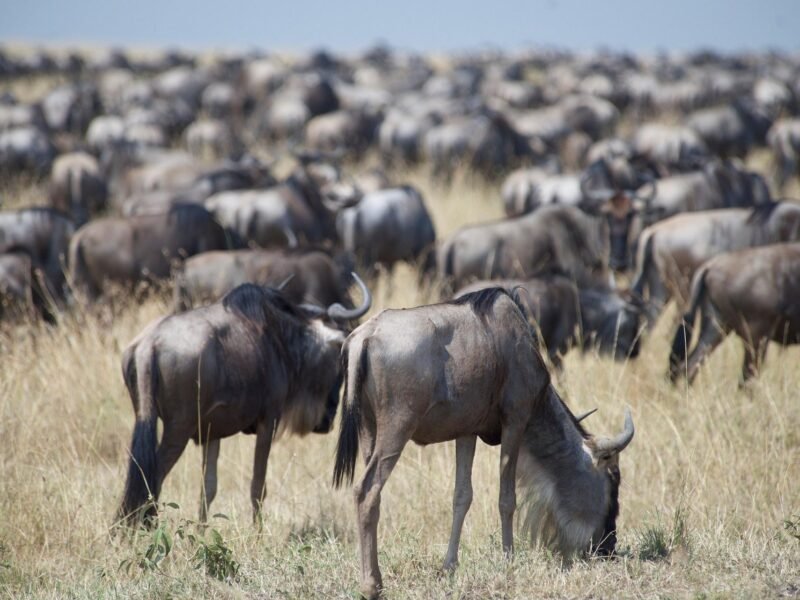
The Serengeti covers roughly 14,750 square kilometres of northern Tanzania and is the country’s best known national park. Its name comes from the Maa word Siringet, meaning the place where the land runs on forever, and the southern plains make the point.
The park is the core of an ecosystem carrying well over a million wildebeest, several hundred thousand zebra and the predators following them. The great migration is not an event on a fixed date but a continuous circuit: calving on the short-grass plains of the south around February, movement north and west through the middle of the year, and the river crossings at the Grumeti and Mara from roughly July to October.
Outside the migration the Serengeti holds resident lion prides on the kopjes, leopard in the riverine woodland along the Seronera valley, cheetah on the open plains and large elephant and buffalo populations. Big cat viewing here is as reliable as anywhere in Africa.
The park works as a three or four night stay on its own, or as the centrepiece of a northern circuit trip taking in Ngorongoro, Tarangire and Lake Manyara. It combines naturally with a Zanzibar beach stay afterwards, which is the route most of our guests take.