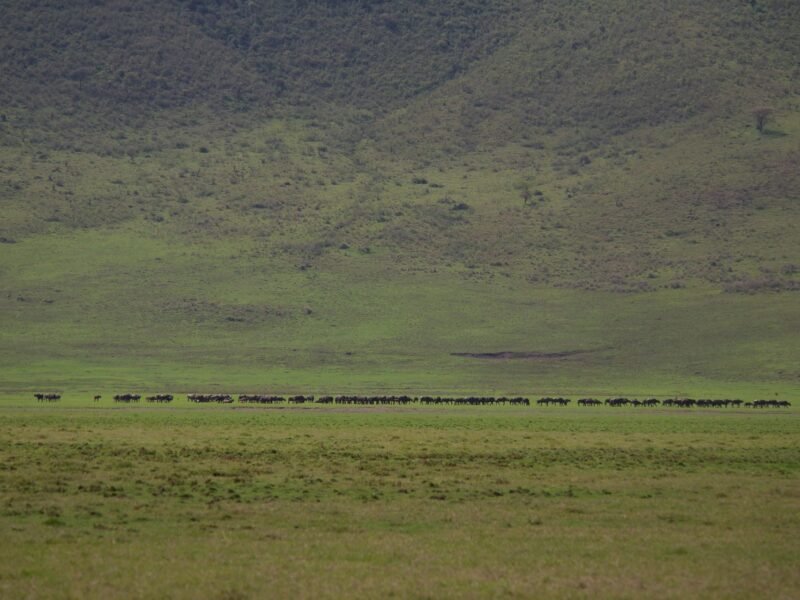
The Ngorongoro Crater is the caldera of a volcano collapsed in on itself some two and a half million years ago. The walls stand about 600 metres above a floor covering roughly 260 square kilometres, and the whole enclosed system holds a permanent population of around 25,000 large animals.
The result is unlike anywhere else on a Tanzanian safari. Grassland, swamp, soda lake and acacia forest sit within a single morning’s drive of each other, and the density of animals within that space means a half-day on the crater floor often produces more sightings than a full day elsewhere.
The crater is one of the few reliable places in Tanzania to see black rhino, and it holds large lion prides, elephant bulls with notably heavy tusks, hippo, buffalo and flamingo on Lake Magadi. It sits within the wider Ngorongoro Conservation Area, a UNESCO World Heritage Site where Maasai communities continue to graze cattle alongside the wildlife.
Olduvai Gorge, where the Leakeys uncovered some of the earliest known hominin remains, lies on the road between the crater and the Serengeti and is worth an hour on the way through.